
BB±
50
Neutral
A stable concession regime, the government's push for domestic supply as proved gas reserves fall to about 4.6 years, and the 25th onshore Bidding Round, which includes two central blocks, offer some upside. However, the basins are small and mature, production is dominated by the long-producing Sirikit field, and Cabinet approval of the round's awards is still pending. Politically, the Anutin government has been in place since the February 2026 election, but the border dispute with Cambodia is unresolved and crossings remain closed, although the conflict lies far from these basins. Outlook: Neutral.
October 8, 2026
Asia - South East
Onshore & Offshore
Oil
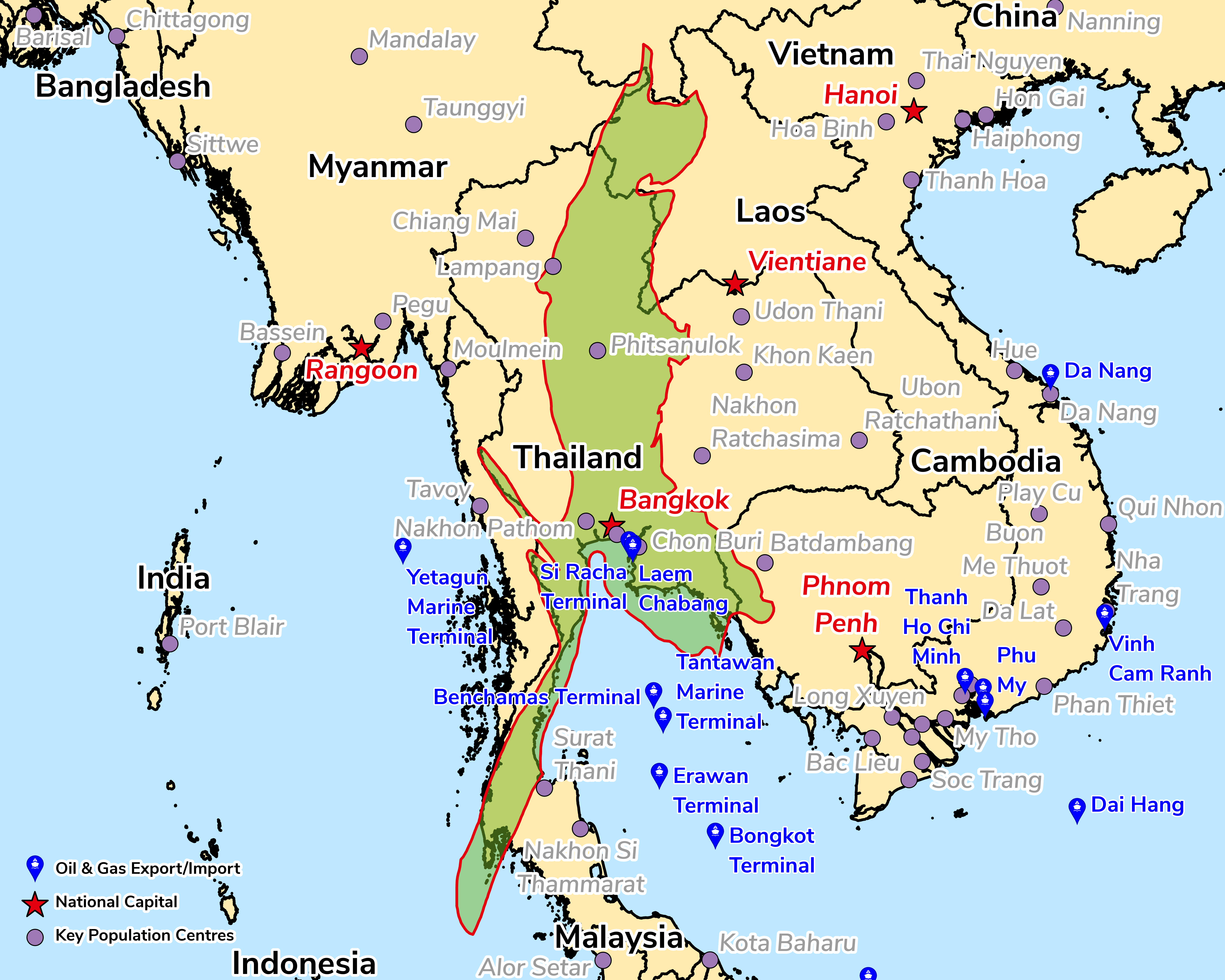
The Thailand Mesozoic Belt (USGS Province 3508, assessed by the USGS as the Thai Cenozoic Basins Province) comprises the belt of onshore Cenozoic rift basins of northern and central Thailand, west of the Khorat Plateau, including the Phitsanulok, Phetchabun, Suphan Buri and Fang basins. The basins developed on pre-Cenozoic basement through multistage extension from the Late Oligocene, which was most pronounced in the Middle Miocene and continued into the Late Miocene, with minor structural inversion. Most are 2–4 km deep, but the Phitsanulok Basin, the largest at about 10,000 km², holds up to 8 km of fill. The fill is continental, comprising fluvial and lacustrine clastics. Organic-rich lacustrine shales, notably the Chum Saeng Formation of the Sukhothai Depression in the Phitsanulok Basin, are the main source rocks, and clastics of the Lan Krabu Formation are the principal reservoirs; in the Wichianburi Sub-basin of the Phetchabun Basin, oil is also produced from fractured volcanic rocks.
Thailand's main onshore oil province. Sirikit, in the Phitsanulok Basin, is the country's largest onshore oil field and has produced around 18,000–24,000 bbl/d; its S1 project remains one of PTTEP's main producing assets in the company's 2026–30 investment plan, with the Lan Sang Arun solar project now supplying power to field operations. Smaller fields produce from the Suphan Buri (U Thong, Sang Kajai), Fang and Phetchabun (Wichianburi) basins. In 2014 the USGS assessed 53 MMbbl of shale oil and 320 bcf of shale gas in the Phitsanulok Basin. The 25th Bidding Round, covering nine onshore blocks (33,445 km²), includes two central blocks, L6/66 and L8/66; five companies submitted eight applications, the DMF has completed its selection, and Cabinet approval of the winners is expected by the end of 2026.
Source: ESRI, BGS, USGS & OGA data

© 2024 Oil & Gas Advisors Limited
Website by Rugby Web Design