6.000
%
Positive
64
mm boe
77
%
While changes to the tax regime have been limited, there is broad acceptance that opening access to independents will revive the flagging upstream sector. The ANPG's permanent offer of blocks, marginal-field incentives and a more flexible approach since leaving OPEC are positive steps, although Sonangol's restructuring and FX constraints remain risks. Outlook maintained because licensing reforms continue to favour independents. Outlook: Positive. Risk premia unchanged at 6%.
October 7, 2026
Africa - South
mm bbl
bcf
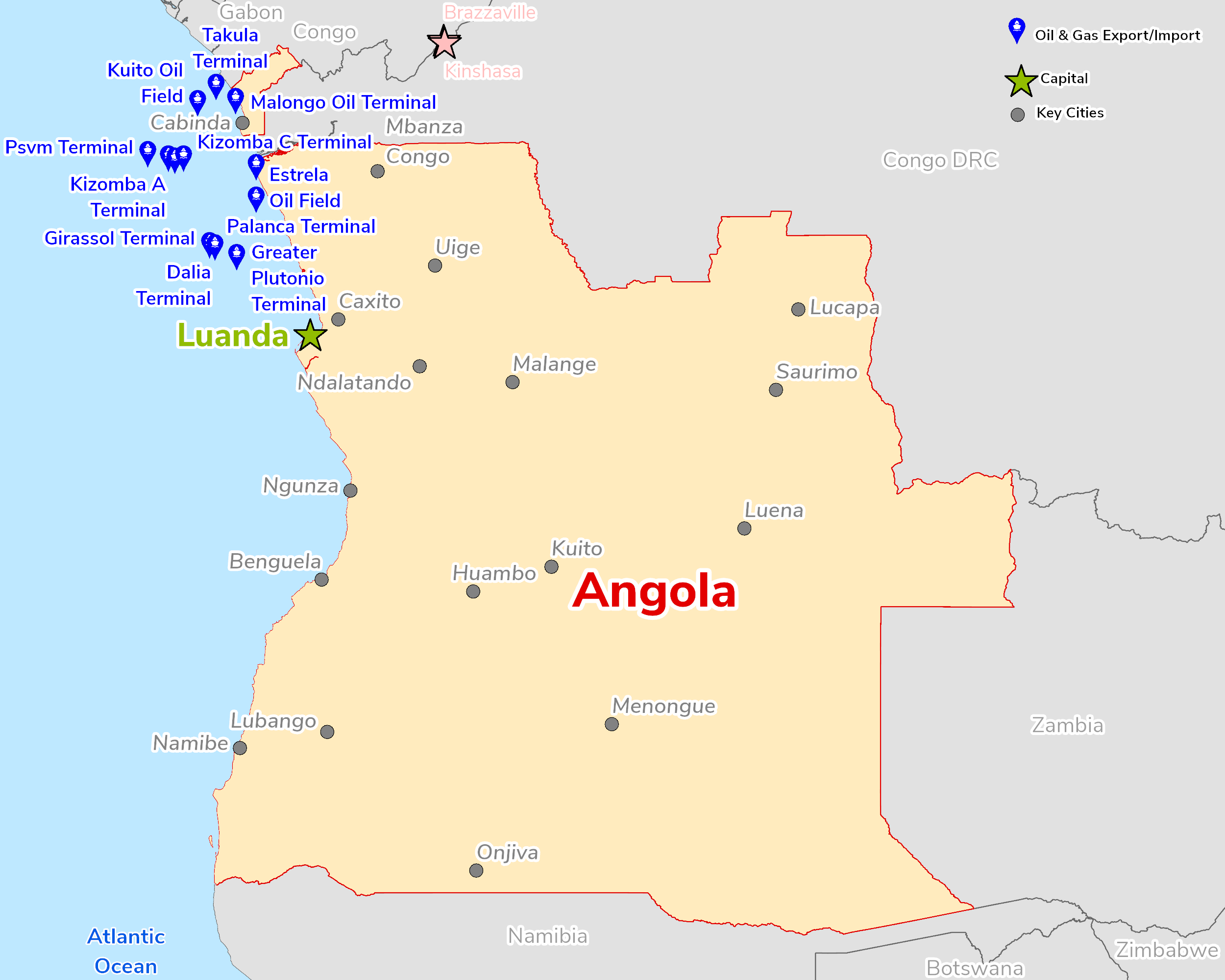
Southern Africa, bordering the South Atlantic Ocean, between Namibia and Democratic Republic of the Congo.
Multiple (PSC/Concession)
Companies operating in Angola do so under two different fiscal regimes: offshore production is subject to production sharing contracts (PSCs), whereas a concession agreement, with tax and royalty payments, applies to onshore production and the shallow water Cabinda concession. Within the PSC regime bonuses and profit oil/gas shares are negotiable – negotiated terms vary widely but generally reflect the perceived strong prospectivity of the area. Oil profits are divided between the investor and the government on a sliding-scale basis linked to rates of returns (IRRs). Deepwater developments benefit from uplift; in situations where large, high-cost development projects are required (i.e., the majority of Angola's deep-water discoveries), capital costs can be uplifted by 40%.
Angola is one of sub-Saharan Africa's two largest oil producers, with oil dominating exports and government revenue; it left OPEC in January 2024 to pursue production growth. President João Lourenço's reforms, including the creation of the ANPG as regulator, the partial privatisation of Sonangol and a new private investment law, have improved the environment. However, US and UK guidance highlight heavy debt service, currency volatility, corruption and bureaucracy. The EIA notes long-term decline from mature deepwater fields, which has prompted incentives for marginal fields, continuous licensing rounds and the first non-associated gas development (the New Gas Consortium).
Source: ESRI, Heritage Index, HMG Foreign & Commonwealth Office, US Department of State, International Trade Administration, International Law Review, Ernst & Young, Wood Makenzie & OGA data.

© 2024 Oil & Gas Advisors Limited
Website by Rugby Web Design


