BBB±
17
Neutral
The USGS sees significant undiscovered potential in the largely untested offshore salt basin, supported by a stable and supportive regime. Onshore activity, however, remains modest and centred on the mature Meskala field. Outlook: Neutral.
October 12, 2026
Africa - North
Offshore
Oil
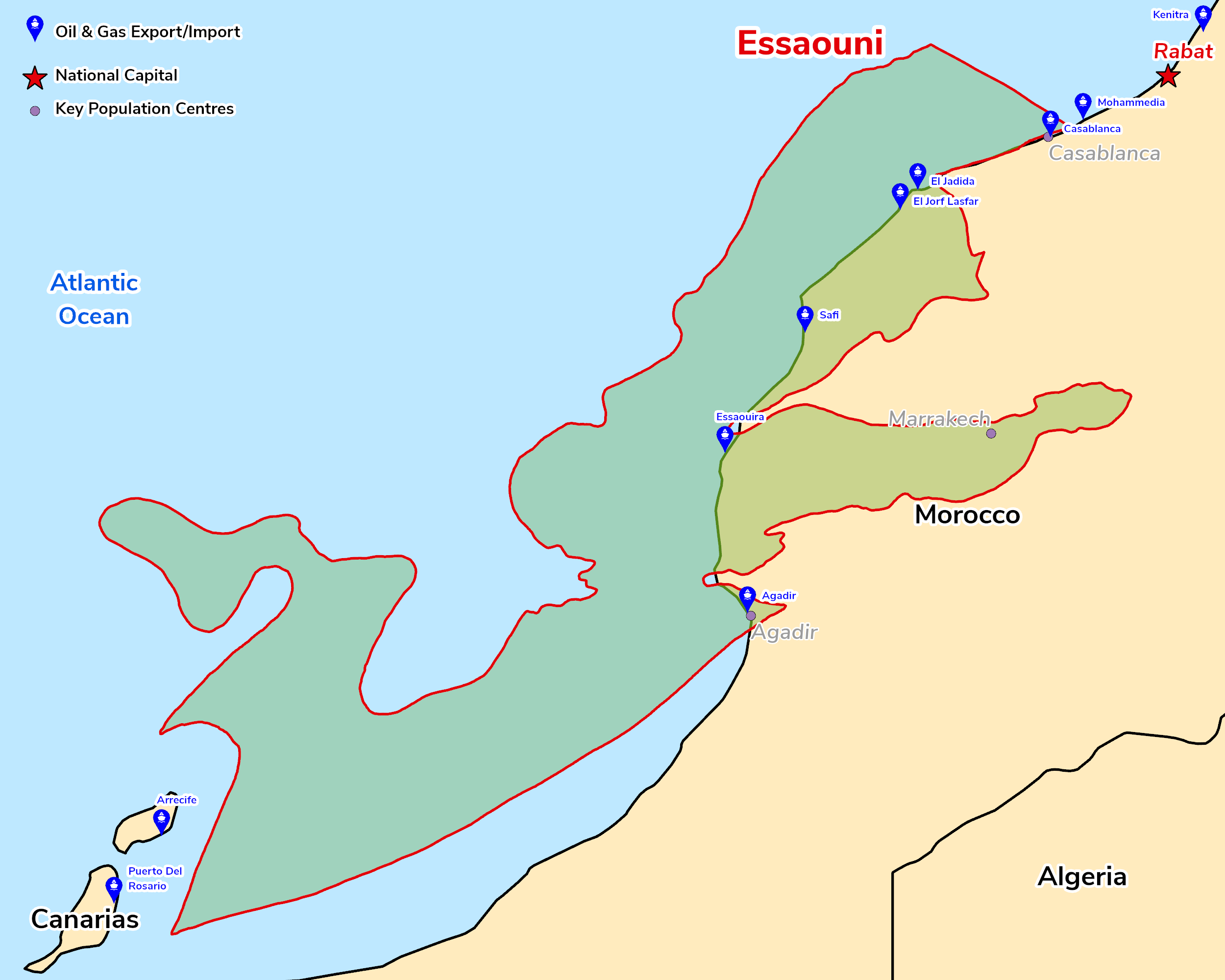
The Essaouira Basin is a NNE–SSW-trending segment of the Atlantic passive continental margin of western Morocco, formed by Triassic rifting during the opening of the Central Atlantic and lying on the Hercynian unconformity. Syn-rift Triassic red beds and evaporites are overlain by Jurassic–Cretaceous post-rift strata, and Triassic salt provides both the seal for fields such as Meskala and the halokinetic structures that deform the overlying section. Potential source rocks include Siluro-Devonian and Lower Oxfordian shales, though the distribution of mature source is limited by shallow burial onshore. Production is modest, from Triassic (TAGI) sandstones in the Meskala gas field (discovered 1977) and smaller Jurassic fields, but the offshore salt basin is considered highly prospective: the USGS estimated mean undiscovered resources of 3.8bn bbl of oil and 20.7tcf of gas offshore Morocco.
The Basin is one of the country's two historic producing areas: the Meskala gas-condensate field has produced since 1987 and supplies gas by pipeline to the OCP phosphate plants at Youssoufia. Onshore activity is modest and led by ONHYM, but the offshore salt basin remains largely untested, with the USGS estimating 3.8bn bbl of oil and 20.7tcf of gas yet to be found.
Source: ESRI, BGS, USGS & OGA data

© 2024 Oil & Gas Advisors Limited
Website by Rugby Web Design