
DDD±
108
Neutral
Barbados' 2026 Offshore Direct Negotiations, covering 19 blocks with awards targeted for January 2027, is the most concrete attempt yet to open the prism to exploration. However, the offshore prism remains undrilled, deep water and complex structure raise costs, and earlier rounds drew limited interest. Outlook: Neutral.
October 8, 2026
Caribbean
Americas - South
Gas
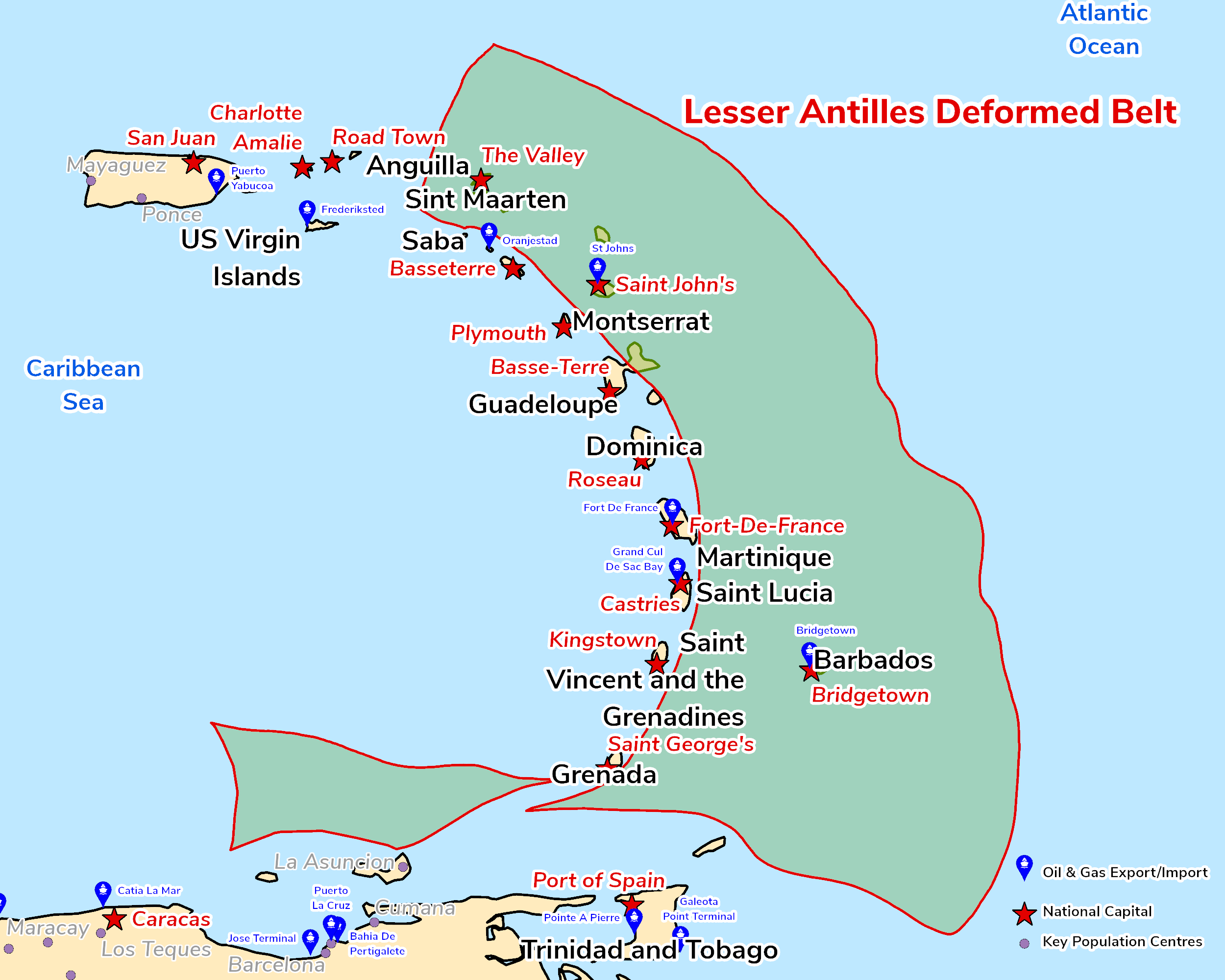
The Lesser Antilles Deformed Belt is the Barbados accretionary prism, one of the thickest and most extensive accretionary prisms in the world. It formed as sediment was scraped off Atlantic oceanic crust subducting beneath the Caribbean Plate and thrust westward against the Lesser Antilles forearc. The prism is dominated by quartz-rich turbidites supplied by the Orinoco fluvial system since the Eocene, and is cut by thrusts, diapirs and mud volcanoes, with piggy-back basins on its upper surface. Barbados island is its highest point. Oil at the Woodbourne Field is sourced from Cretaceous marine shales, which points to potential in deeper reservoirs across the prism.
Oil seeps, manjak (solid bitumen) deposits and the onshore Woodbourne Field, which has produced about 9mm bbl, prove a working petroleum system, but the offshore prism remains undrilled and earlier licensing attracted limited interest. In June 2026, Barbados launched the 2026 Offshore Direct Negotiations, offering 19 shelf and deepwater blocks covering about 62,600 sq km, down from 22 in the 2022 round. Pre-qualification closed on 1 September 2026, with Cabinet decisions on awards targeted for 15 January 2027. Exploration licences run for up to eight years, and the state may take a 10–20% stake.
Source: ESRI, BGS, USGS & OGA data

© 2024 Oil & Gas Advisors Limited
Website by Rugby Web Design