
CC§
97
Uncertain
The Paz government's turn away from MAS policy, its priority on northern La Paz gas and the pending reform of Hydrocarbons Law 3058 could reopen the area to private investment, and the Tomachi source rock is among the richest in South America. Against this, the hydrocarbons law has not yet been passed, the fiscal take may still reach 50%, the FX crisis weighs on investment, and the basin is remote, costly to operate in, lacks infrastructure and has no commercial discovery after decades of sporadic drilling. Outlook improves only if the new law is enacted and draws operators to the north. Outlook: Uncertain.
October 8, 2026
Americas - South
Onshore
-
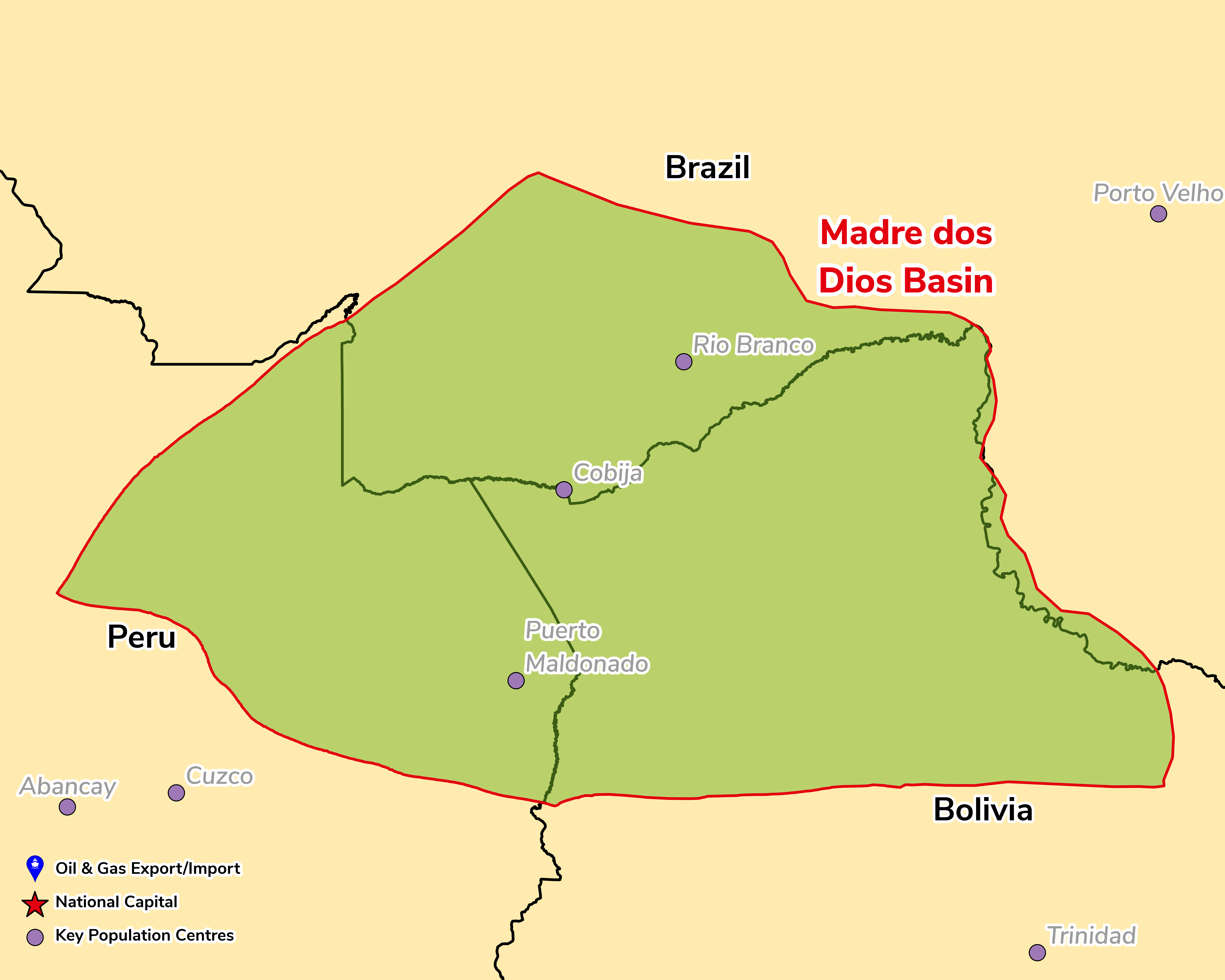
The Madre dos Dios Basin (USGS Province 6043; usually written Madre de Dios) is the Bolivian part of a Sub-Andean foreland basin that spans northern Bolivia and south-eastern Peru, lying in the Amazon lowlands of Pando, northern La Paz and Beni. It is bounded by the Sub-Andean thrust belt to the south and south-west, the Brazilian Shield to the north and the Beni Basin to the east. Palaeozoic sediments accumulated in an intracratonic and then broad pericratonic setting on the western margin of Gondwana, and the basin evolved into the present asymmetric foreland only from the Mesozoic, with Tertiary Andean loading. The Devonian section is more than 1,000 m thick. The principal source rock is the Upper Devonian (Frasnian–Famennian) Tomachi Formation, an oil-prone marine shale averaging around 3.5% TOC over some 200 m, with the Middle Devonian Tequeje and the Upper Carboniferous–Lower Permian Copacabana formations as further sources. Maturity rises from immature near the north-eastern margin to post-mature towards the thrust belt, with oil generation from the Miocene onwards, after the traps formed.
A largely unexplored frontier with no commercial production on the Bolivian side. Mobil drilled five wells in the 1990s, including Pando X-1, which recovered oil from Upper Tomachi sandstones. In total fewer than a dozen exploration wells have been drilled and no significant reserves found, despite the source rock's estimated generative capacity of 250–1,000 billion boe. Seismic coverage is limited to scattered 2D. Interest is now driven by government policy: President Rodrigo Paz has made gas development in northern La Paz, including the nearby Mayaya block in the Sub-Andean belt, a priority and aims for production within two years. Bill 756/2025-2026, which reforms Hydrocarbons Law 3058 and would allow unconventional resources, is before the Assembly, and at the end of September 2026 the government said it was also preparing a short law to speed up projects. YPFB's 2026 budget includes US$282m for exploration nationwide.
Source: ESRI, BGS, USGS & OGA data

© 2024 Oil & Gas Advisors Limited
Website by Rugby Web Design