
12.500
%
Negative
134
mm boe
63
%
The fall of the Assad regime in December 2024 and the lifting of most US, UK and EU sanctions have transformed the outlook, with Gulf-backed power projects and early IOC interest. However, sectarian violence, Israeli strikes, unresolved integration of the Kurdish-held north-east, where the main oil fields lie, and destroyed infrastructure mean the region remains a difficult place to operate. Outlook amended from Negative because the end of the civil war and sanctions relief have removed the main barriers, although risks remain high. Outlook: Uncertain. Risk premia lowered from 15% to 12.5%.
October 8, 2026
Middle East
mm bbl
bcf
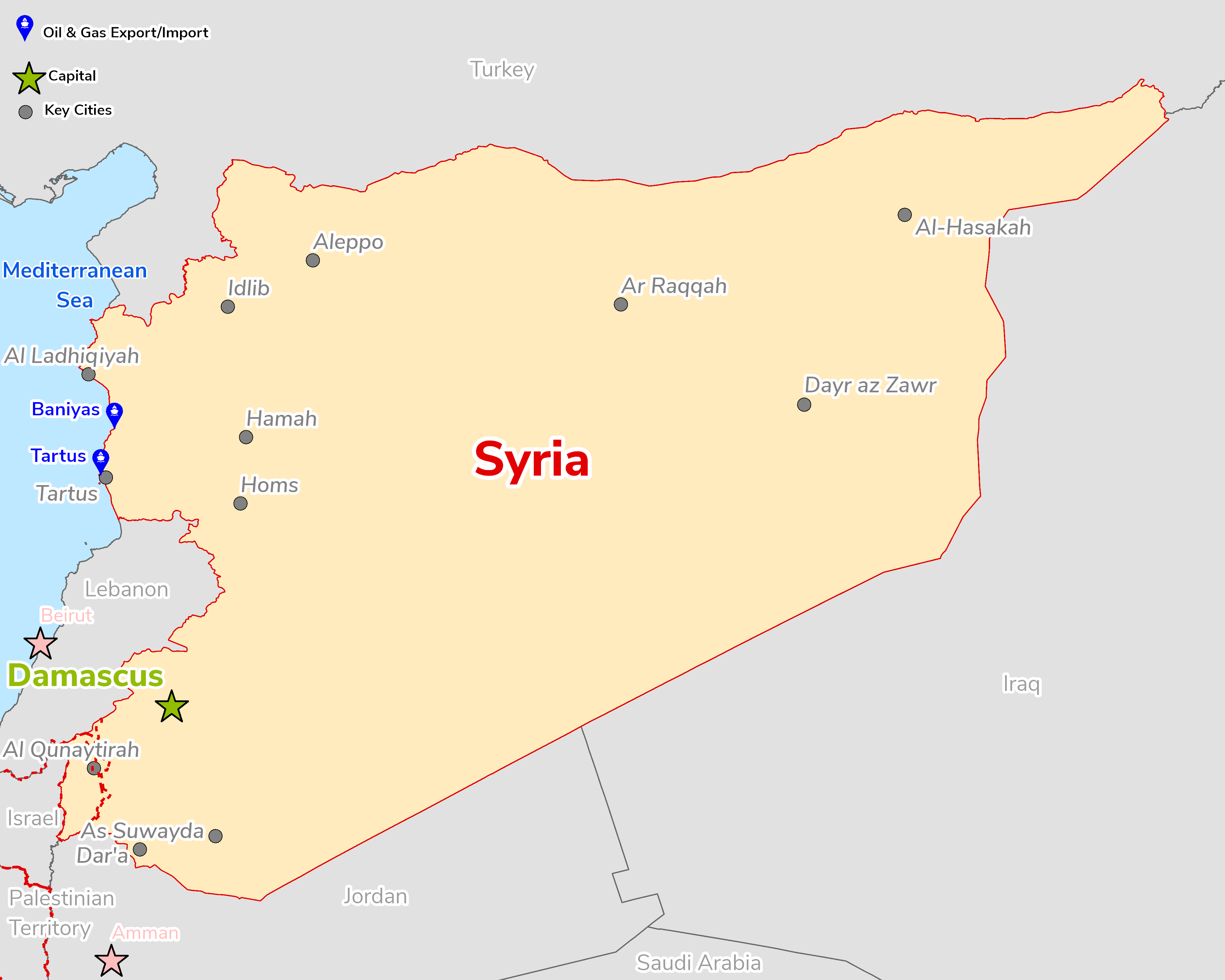
Middle East, bordering the Mediterranean Sea, between Lebanon and Turkey.
PSC/PSA
Production sharing regime. IOCs have historically operated under PSCs with the Syrian Petroleum Company (SPC), first introduced in 1985, alongside some service contracts. On a commercial discovery a joint operating company owned 50:50 by SPC and the contractor is formed; the contractor funds exploration, recovers costs from a capped share of production and shares profit oil on a sliding scale, with income tax paid from the State's share. Following the fall of the Assad government in December 2024 and the easing of most US, UK and EU sanctions during 2025, the interim government has begun discussing new upstream agreements, but the framework has yet to be updated.
Bashar al-Assad's regime fell in December 2024, and the transitional government under President Ahmed al-Sharaa has secured the lifting of most US, UK and EU sanctions, but sectarian violence on the coast and in Sweida in 2025 and Israeli strikes remain risks. The FCDO advises against all travel, and investors face destroyed infrastructure, weak institutions and residual sanctions risk. The EIA notes that oil output is a fraction of pre-war levels. The main fields lie in the Kurdish-held north-east, whose integration with Damascus was agreed in principle in 2025, and Gulf-backed power projects are under way.
Source: ESRI, Heritage Index, HMG Foreign & Commonwealth Office, US Department of State, International Trade Administration, International Law Review, Ernst & Young, Wood Makenzie & OGA data.

© 2024 Oil & Gas Advisors Limited
Website by Rugby Web Design


